How Virtual Assistants Help Businesses Scale Faster
In 2026, businesses are under constant pressure to grow faster, reduce costs, and operate more efficiently. Whether it is a startup, marketing agency, eCommerce store, SaaS company, or local service business, scaling requires more than just increasing sales—it requires better systems, smoother operations, and consistent execution. One of the most effective solutions enabling this growth is the use of virtual assistants (VAs).
Virtual assistants have evolved from simple administrative helpers into highly skilled professionals who support marketing, sales, customer service, operations, and even AI-driven workflows. Today, they play a key role in helping businesses scale without the heavy costs of hiring full-time employees.
In this guide, we will explore how virtual assistants help businesses scale faster in 2026, their key roles, benefits, and how companies can use them effectively.
What Is a Virtual Assistant?
A virtual assistant is a remote professional who provides administrative, technical, creative, or operational support to businesses.
Unlike traditional employees, virtual assistants work remotely and are typically hired on a part-time, full-time, or project-based basis.
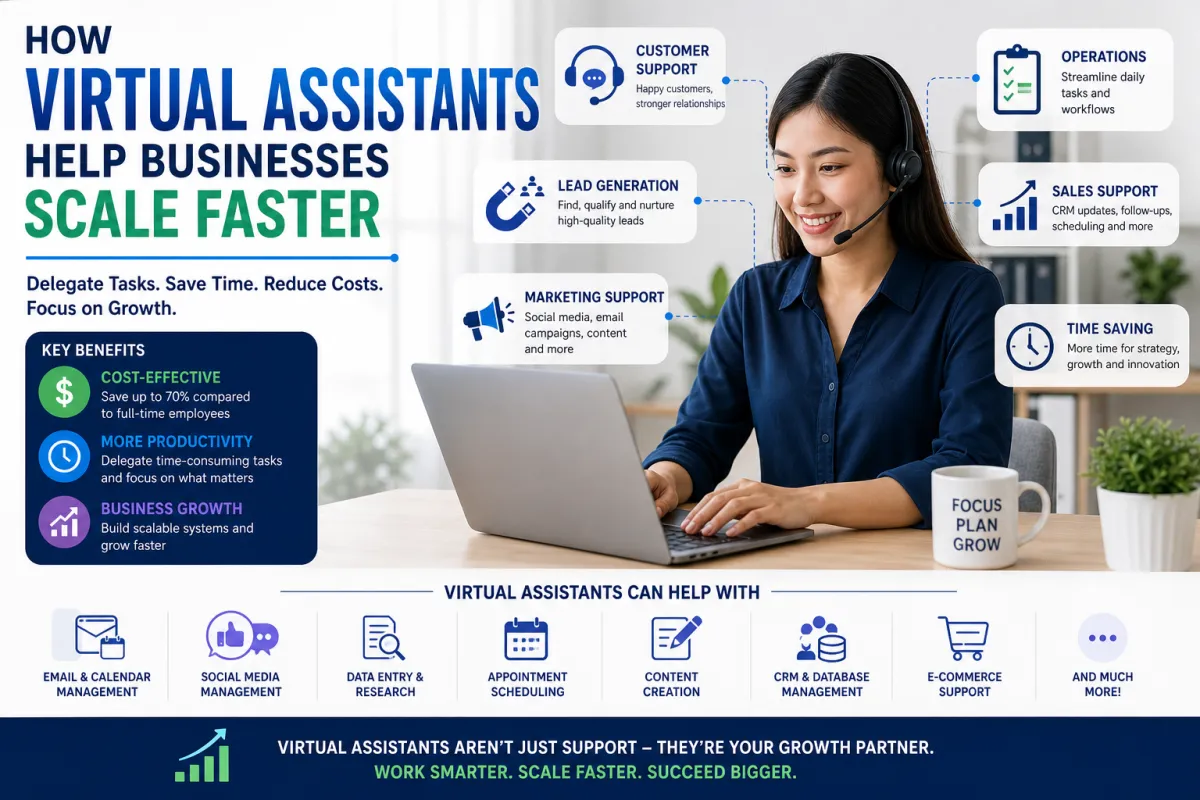
They can handle tasks such as:
Email management
Customer support
Social media management
Lead generation
Appointment scheduling
Data entry
CRM updates
Content creation
Marketing support
With advancements in technology and AI tools, virtual assistants in 2026 are more efficient and capable than ever before.
Why Virtual Assistants Matter in 2026
Modern businesses face several challenges:
Limited time for daily operations
High hiring and training costs
Increasing workload from digital marketing
Need for 24/7 customer support
Fast-paced competition
Virtual assistants solve these problems by providing flexible, cost-effective support that helps businesses stay productive and scalable.
Instead of hiring multiple full-time employees, businesses can delegate tasks to virtual assistants and focus on core growth activities.
1. Virtual Assistants Reduce Operational Workload
One of the biggest advantages of virtual assistants is workload reduction.
Business owners often spend too much time on repetitive tasks such as:
Responding to emails
Scheduling meetings
Updating CRM records
Managing social media posts
Following up with leads
Virtual assistants take over these tasks, allowing business owners and teams to focus on strategy, sales, and growth. This significantly improves productivity across the organization.
2. Virtual Assistants Improve Lead Generation
Lead generation is essential for business growth, but it can be time-consuming.
Virtual assistants help by:
Collecting leads from different sources
Managing CRM databases
Qualifying potential customers
Sending follow-up messages
Scheduling sales calls
For example, a VA can monitor incoming inquiries and immediately respond or route them to the sales team. This ensures no lead is missed and improves conversion rates.
3. Virtual Assistants Enhance Customer Support
Customer support is critical for maintaining satisfaction and loyalty.
Virtual assistants can handle:
Live chat support
Email responses
FAQ handling
Ticket management
Order updates
With proper training and tools, VAs can provide fast and reliable support that improves customer experience. In many cases, they work alongside AI chatbots to deliver 24/7 assistance.
4. Virtual Assistants Support Marketing Activities
Marketing requires consistency and execution.
Virtual assistants help businesses with:
Social media posting
Content scheduling
Email marketing campaigns
Blog formatting and publishing
Ad campaign monitoring
This ensures that marketing efforts run smoothly without requiring constant attention from business owners.
5. Virtual Assistants Improve Sales Efficiency
Sales teams benefit greatly from VA support.
Virtual assistants can:
Qualify leads before sales calls
Update CRM pipelines
Send follow-up messages
Remind prospects about meetings
Track sales performance data
This allows sales teams to focus on closing deals instead of administrative work.
6. Virtual Assistants Help Scale Without High Costs
Hiring full-time employees is expensive due to:
Salaries
Benefits
Training
Office space
Virtual assistants provide a cost-effective alternative.Businesses only pay for the work they need, making it easier to scale operations without increasing overhead costs significantly.
This is especially useful for startups and small businesses.
7. Virtual Assistants Improve Time Management
Time is one of the most valuable business resources.
Virtual assistants help save time by:
Handling repetitive tasks
Managing schedules
Organizing workflows
Prioritizing tasks
This allows business leaders to focus on high-value activities like strategy, partnerships, and growth.
8. Virtual Assistants Increase Productivity
When tasks are delegated properly, productivity increases across the entire organization.
Teams can:
Work faster
Reduce stress
Avoid multitasking overload
Focus on specialized tasks
This leads to better overall performance and faster business growth.
9. Virtual Assistants Support E-commerce Growth
E-commerce businesses rely heavily on customer interaction and order management.
Virtual assistants help by:
Managing product listings
Handling customer inquiries
Processing orders
Managing returns and refunds
Tracking shipments
This improves customer satisfaction and operational efficiency.
10. Virtual Assistants Work Alongside Automation Tools
In 2026, virtual assistants often work with automation platforms such as:
CRM systems
Email automation tools
Social media schedulers
AI chatbots
They manage exceptions, monitor workflows, and ensure systems run smoothly.
For example:
Automation sends emails
VA monitors responses and follows up manually when needed
This combination of human + automation is extremely powerful.
Industries That Benefit from Virtual Assistants
1. Marketing Agencies
Client onboarding
Campaign management
Reporting
2. SaaS Companies
Customer onboarding
Support tickets
Lead nurturing
3. Real Estate
Lead follow-ups
Appointment scheduling
CRM updates
4. Healthcare
Appointment reminders
Patient communication
5. eCommerce
Order management
Customer support
Challenges of Using Virtual Assistants
While VAs offer many benefits, businesses may face challenges such as:
Communication gaps
Training requirements
Quality control issues
Time zone differences
However, these challenges can be managed with proper onboarding and clear processes.
Best Practices for Working with Virtual Assistants
To get the best results, businesses should:
Provide clear instructions
Use standard operating procedures (SOPs)
Use communication tools like Slack or WhatsApp
Set performance expectations
Use CRM systems for task tracking
Proper structure ensures maximum efficiency.
The Future of Virtual Assistants in 2026
Virtual assistants are becoming more advanced with AI integration.
Future trends include:
AI-assisted virtual assistants
Hybrid human + AI teams
Automated task delegation systems
Real-time analytics support
Voice-based assistants for business operations
Businesses that combine VAs with AI tools will scale faster than competitors.