GoHighLevel Custom Snapshots for Agencies: Build Repeatable Client Systems
Marketing agencies often discover the same problem as their client base grows.The first few GoHighLevel accounts are manageable because the team can build each system manually.Then the agency adds more clients. Suddenly, the team is rebuilding the same pipelines, workflows, forms, calendars, settings, and campaign structures again and again.
The problem isn’t GoHighLevel itself.The problem is the lack of a repeatable implementation system.This is where GoHighLevel custom snapshots can become valuable. A well-designed snapshot can give an agency a reusable foundation for creating new client environments while reducing repetitive setup work.But a snapshot should not simply be a collection of everything inside an existing account.The better approach is to create a deliberate architecture containing the components the agency actually wants to replicate.
At GHL Wizards, we help agencies design custom GoHighLevel systems and snapshots around their repeatable service models, while keeping unnecessary client-specific clutter out of the reusable foundation.
What Is a GoHighLevel Snapshot?
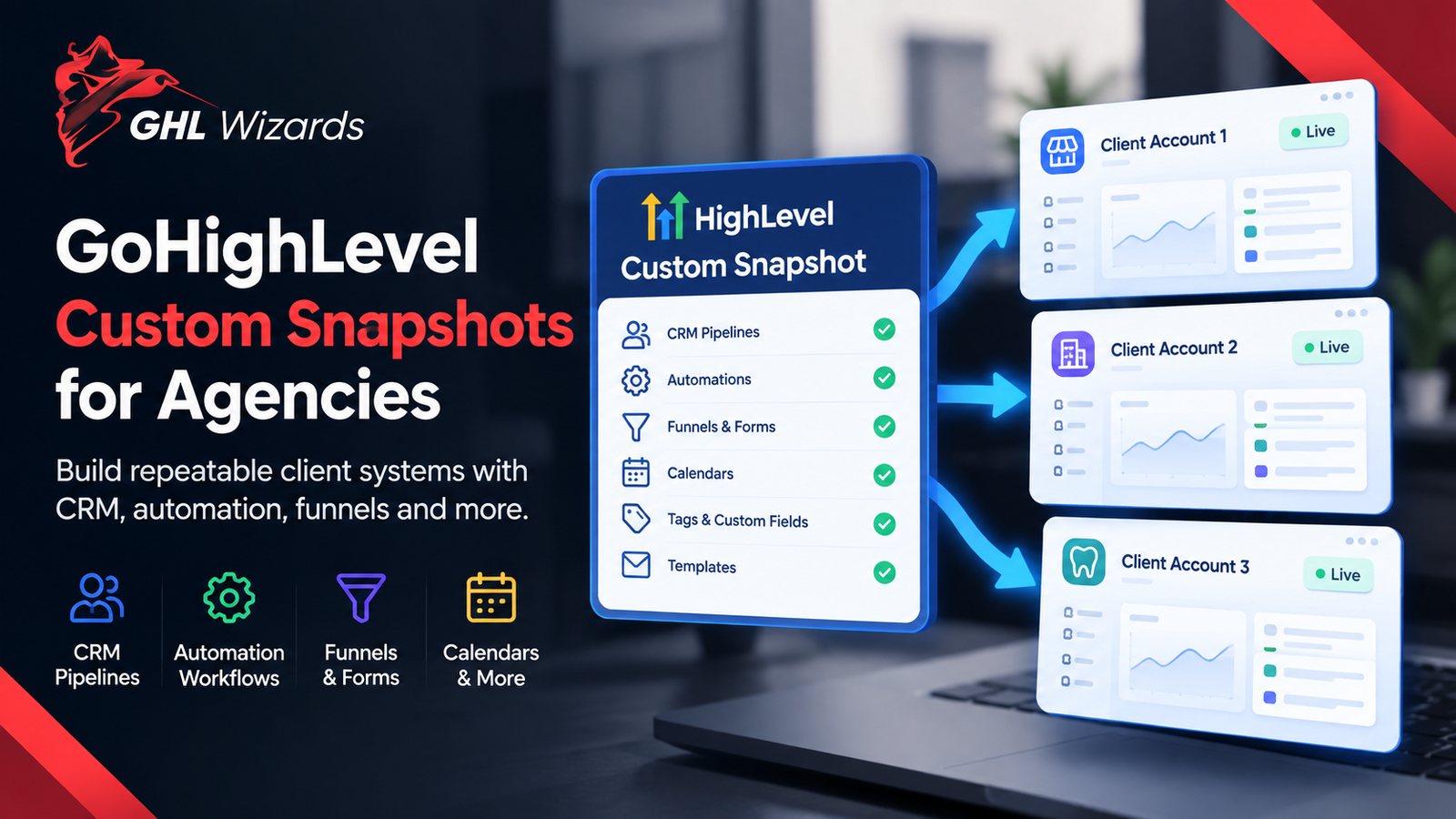
A GoHighLevel snapshot is a reusable configuration that can be used as a foundation for setting up other GoHighLevel sub-accounts.For an agency, this can mean creating a standardized starting point for a particular type of client.
For example, an agency serving dentists might create a snapshot containing a foundational structure for:
- Lead capture
- CRM pipelines
- Appointment calendars
- Follow-up workflows
- Forms
- Basic campaign assets
- Tags
- Custom fields
- Other reusable components
When a new client joins, the agency can use the snapshot as the starting point and then customize it. This is fundamentally different from building every account from zero.
Why Agencies Need Repeatable GoHighLevel Systems
Agency growth creates repetition. If an agency serves 30 businesses, it may not want to manually rebuild the same basic infrastructure 30 times.
A repeatable system can help standardize:
- Account architecture
- Pipeline structure
- Lead routing
- Appointment processes
- Workflow logic
- Naming conventions
- Client onboarding
This does not mean every client should receive an identical account.Instead, the snapshot provides the reusable foundation.Client-specific requirements can then be added or modified.
The Difference Between a Snapshot and a Complete Client Account
This distinction is important.A client account contains information specific to that client. A reusable snapshot should contain components that make sense to replicate.
For example, a client’s:
- Personal contact records
- Historical conversations
- Unique payment information
- Client-specific branding
- One-off campaigns
- Temporary workflow tests
may not belong in the reusable foundation.The snapshot should be intentionally designed.
The question should be:
“Would we want this component in the next client account?”
If the answer is no, it probably should not be part of the standard snapshot architecture.
What Should a GoHighLevel Agency Snapshot Include?
The exact structure depends on the agency.
However, common reusable components can include:
CRM Pipeline
A standardized pipeline can provide the basic structure for managing opportunities.
Custom Fields
Fields that apply to the agency’s standard client process can be included.
Tags
Consistent tagging can help support segmentation and workflow logic.
Workflows
Repeatable automations can form a major part of the snapshot.
Calendars
If clients use a similar appointment structure, calendars can provide a starting point.
Forms and Funnels
Reusable lead capture assets can accelerate deployment.
Templates
Standardized email, SMS, or other campaign templates can help maintain consistency. The agency should still review every component before client launch.
Build the Snapshot Around the Agency’s Offer
One of the strongest approaches is to start with the service the agency sells.
For example, suppose an agency offers a “Lead Generation System” to local service businesses.
The snapshot could be designed around that offer.
The architecture might include:
Lead Form → CRM → Pipeline → Immediate Follow-Up → Appointment → Reminder → Sales Follow-Up
This creates a reusable system aligned with the agency’s actual product. If the agency changes its offer, the snapshot can evolve as well.
Snapshot Architecture for Local Service Businesses
Consider an agency serving:
- HVAC companies
- Roofing companies
- Plumbers
- Electricians
- Cleaning companies
The individual businesses are different, but they may share common operational patterns.
They may all need:
- Lead capture
- Service inquiry tracking
- Appointment scheduling
- Follow-up
- Missed-call response
- Lead reactivation
An agency can create a foundational snapshot around these shared requirements. The individual client can then customize services, locations, messaging, calendars, and branding.
Snapshot Architecture for Professional Services
Professional services may require a different structure.
A reusable snapshot might include:
- Consultation form
- Qualification process
- Discovery-call calendar
- Proposal stage
- Follow-up workflow
- Client onboarding
- Internal notifications
Again, the snapshot is a foundation rather than a finished client account.
Why Naming Conventions Matter
A snapshot becomes difficult to manage when the agency has inconsistent names everywhere.
Imagine one workflow is called:
“New Lead Follow Up”
another is:
“Lead Nurture 1”
another is:
“NEWLEAD SMS”
and another is:
“Workflow – New Leads – Old”
Over time, this becomes difficult to maintain.
A snapshot should have clear naming conventions.
For example:
WF — Lead — New Inquiry
WF — Appointment — Reminder
WF — Lead — Reactivation
PIPE — Sales
Clear naming makes troubleshooting and future updates easier.
Snapshot Versioning
Agencies should also think about version control.
As the agency improves its systems, the snapshot may need updates.
For example:
Snapshot V1
Initial CRM and workflow structure.
Snapshot V2
Improved lead routing.
Snapshot V3
Updated appointment process.
Snapshot V4
New AI integration.
The exact versioning method can vary. The important point is that agencies should know which version they are deploying.This prevents confusion when different client accounts were created from different generations of the system.
Testing Before Deploying a Snapshot
A snapshot should not be treated as automatically perfect.Before using a revised snapshot across multiple clients, the agency should test it.
Testing can include:
- Form submissions
- Contact creation
- Pipeline movement
- Workflow triggers
- Appointment booking
- Notifications
- SMS/email actions
- Links
- Mobile behavior
- Internal handoffs
GHL Wizards’ current agency delivery process includes QA before client handover, including testing forms, calendars, workflows, links, handoffs, and mobile behavior. That same mindset is valuable when maintaining reusable snapshots.
Don’t Put Client-Specific Logic Into the Core Snapshot
One of the easiest ways to create a messy snapshot is to keep adding exceptions.
Client A needs a special workflow.
Client B needs another special field.
Client C uses a completely different calendar.
Soon the reusable snapshot contains dozens of exceptions that don’t belong to most accounts.
A better approach is to keep the core foundation focused.
Client-specific requirements can be added after deployment.
This makes the snapshot easier to maintain and reduces unnecessary complexity.
Snapshots and Agency Onboarding
A good snapshot can shorten the technical portion of client onboarding.
Instead of beginning with an empty account, the agency starts from an established foundation.
The onboarding process can then look like:
Client Intake → Snapshot Deployment → Customization → Integration → Testing → Handover
This can make responsibilities clearer.
The agency can identify which components are standard and which components require client-specific work.
Snapshots and White-Label Fulfillment
Snapshots can also work alongside white-label support.
An agency can maintain its own standard architecture while a technical delivery partner handles implementation.
For example:
Agency Strategy → Snapshot → Technical Build → QA → Client Handover
This can help agencies scale delivery without requiring every internal team member to become a GoHighLevel implementation specialist. GHL Wizards currently provides white-label onboarding and technical fulfillment that includes account setup, funnels, CRM, workflows, snapshot deployment, QA, handover, and ongoing support.
Snapshots and AI
AI introduces another reason to maintain clean reusable architecture. If an agency repeatedly deploys AI-related systems, the snapshot can provide a consistent foundation for the surrounding CRM and workflow structure.
For example:
Lead Capture → AI Qualification → CRM → Appointment → Follow-Up
The exact AI configuration may still need to be customized for each client. But the supporting architecture can be standardized.
When Should an Agency Build a Custom Snapshot?
A snapshot can become valuable when an agency repeatedly delivers similar systems.
Some signs include:
- Rebuilding the same workflows repeatedly
- Recreating similar pipelines
- Repeating the same onboarding tasks
- Serving similar client types
- Maintaining similar lead-generation systems
- Spending too much time on repetitive technical setup
The snapshot doesn’t have to contain everything. It needs to contain the right reusable foundation.
Common Snapshot Mistakes
Copying an Entire Client Account
A snapshot should be intentionally designed rather than blindly duplicated.
Including Old Test Workflows
Temporary experiments can create confusion later.
No Naming Standard
Poor naming makes reusable systems difficult to maintain.
No Documentation
Team members need to understand what the snapshot contains and what must be customized.
No QA
Every new snapshot version should be tested.
Making the Snapshot Too Generic
A snapshot that tries to work for every industry may become too broad to be useful.
Focused snapshots can often be easier to manage.
How GHL Wizards Helps With Custom Snapshots
GHL Wizards currently offers Custom Snapshot services for agencies, multi-location businesses, and repeatable service models. The focus is on creating reusable GoHighLevel architecture without carrying unnecessary account clutter into every new implementation.
A snapshot can be designed around:
- CRM structure
- Pipelines
- Workflows
- Forms
- Calendars
- Funnels
- Tags
- Custom fields
- AI-related processes
- Agency onboarding
The objective is to give the agency a reusable technical foundation that can be adapted to individual clients.
Frequently Asked Questions
What is a GoHighLevel snapshot?
A snapshot is a reusable GoHighLevel account configuration that can provide a starting foundation for other sub-accounts.
Why do agencies use GoHighLevel snapshots?
Agencies use snapshots to reduce repetitive setup work and create more consistent client implementations.
Should every client use the exact same snapshot?
Not necessarily. A snapshot should provide a reusable foundation while allowing client-specific customization.
Can workflows be included in a snapshot?
Reusable workflow architecture can be part of a snapshot. Agencies should review and test workflows before deploying them to client accounts.
Can snapshots help with agency scaling?
They can help standardize technical delivery and reduce repeated implementation work, particularly when an agency serves similar types of clients.
Can GHL Wizards build a custom GoHighLevel snapshot?
Yes. GHL Wizards currently offers Custom Snapshot services designed around agencies, multi-location businesses, and repeatable service models.
Conclusion
GoHighLevel snapshots can give agencies something more valuable than a collection of templates: a repeatable implementation foundation. When the snapshot is designed properly, agencies can standardize CRM architecture, workflows, forms, calendars, and other reusable components while still customizing each account for the individual client. The key is discipline.
A snapshot should contain what the agency genuinely wants to repeat—not every setting, experiment, or client-specific detail from an old account.For agencies that repeatedly build similar GoHighLevel systems, a well-structured snapshot can become an important part of the delivery infrastructure.
If your team is rebuilding the same GoHighLevel systems for every new client, GHL Wizards can help you turn that repeated work into a structured, reusable snapshot architecture. Explore the Custom Snapshot service and build a GoHighLevel foundation your agency can use again and again.