When a potential customer visits your website, sends a message, or starts a conversation, there is often a short window in which your business can turn that interest into a real sales opportunity. The problem is that businesses cannot always respond immediately.
A team member may be on a sales call. The office may be closed. A salesperson may already be handling several leads. Even during business hours, responding manually to every question can consume a significant amount of time.This is where an AI chatbot connected to GoHighLevel can become useful.
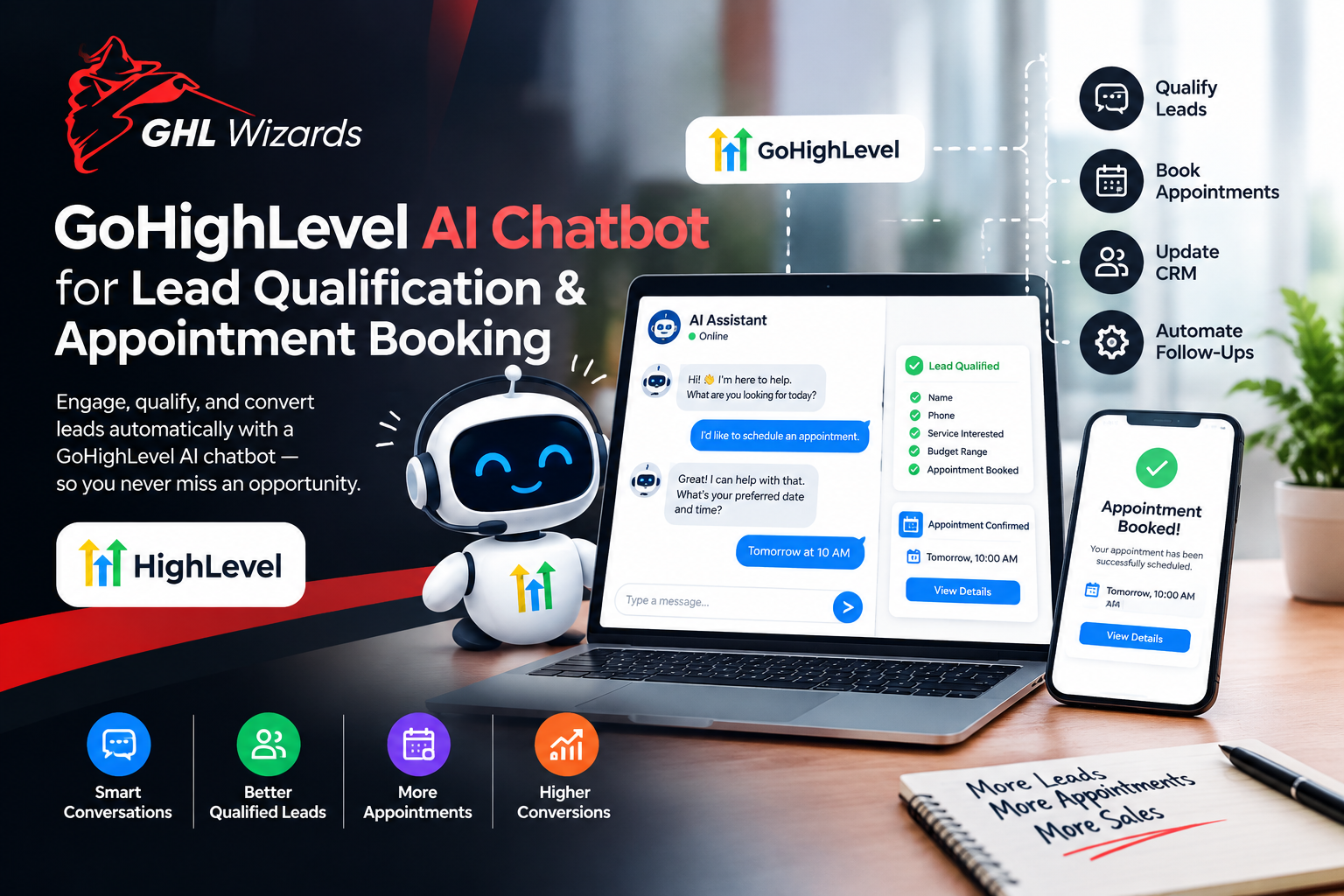
A properly configured GoHighLevel AI chatbot can interact with prospects, answer common questions, collect relevant information, help qualify inquiries, and guide suitable prospects toward booking an appointment. The goal is not simply to put a chatbot on a website. The real objective is to create a conversational system that supports the sales process while giving prospects a clear and useful path forward.
At GHL Wizards, we help businesses implement AI chat and voice solutions within their broader GoHighLevel systems so conversations can connect with CRM records, workflows, appointments, and follow-up processes.
What Is a GoHighLevel AI Chatbot?
A GoHighLevel AI chatbot is an automated conversational assistant that can interact with prospects and customers through supported communication channels. Unlike a basic form, a conversational AI system can ask questions based on what the visitor says and guide the conversation toward a relevant next step.
For example, instead of presenting a visitor with a long contact form, the chatbot might begin by asking what they are looking for.
The prospect could explain their situation in their own words.
The chatbot can then ask follow-up questions relevant to the request.
Depending on the business and configuration, the conversation may eventually lead to:
- Contact information collection
- Lead qualification
- Service recommendations
- Appointment booking
- Human handoff
- CRM updates
- Follow-up automation
The quality of the result depends heavily on how the AI system is configured.
Why Businesses Are Using AI for Lead Qualification
Lead qualification is often repetitive.
Salespeople may ask the same basic questions dozens of times every week:
- What service are you interested in?
- Where are you located?
- What type of project do you have?
- When are you looking to get started?
- Have you worked with a provider before?
- What is the approximate scope of the project?
These questions can help determine whether a prospect is appropriate for the business.
An AI chatbot can handle some of this initial information gathering, allowing sales staff to focus on conversations that require human judgment.
For a small business, that can mean less time spent manually collecting basic information.
For an agency, it can create a more scalable front-end sales process.
AI Qualification Should Be Based on Your Actual Business
One of the biggest mistakes businesses can make is expecting an AI chatbot to qualify leads without first defining what a qualified lead actually means.
Qualification criteria vary considerably.
For example, a marketing agency might qualify leads based on:
- Business type
- Current marketing activity
- Monthly marketing budget
- Services required
- Team size
- Timeline
A home-service company may care more about:
- Service location
- Type of job
- Property type
- Project urgency
- Required service
A professional service business could use entirely different criteria.
The chatbot should therefore be configured around the company’s actual sales process rather than generic qualification questions.
How AI Lead Qualification Can Work
A typical AI qualification process might look like this:
Step 1: Start the Conversation
The visitor initiates a conversation through the available chat channel.
The AI introduces itself and asks how it can help.
Step 2: Understand the Request
The prospect describes what they need.
The AI can identify the general purpose of the inquiry and ask relevant follow-up questions.
Step 3: Collect Important Information
The chatbot can request details that the business needs to evaluate the opportunity.
Step 4: Determine the Appropriate Next Step
If the prospect appears suitable, the AI can guide them toward booking an appointment.
If more information is required, it can continue the conversation.
If the inquiry requires human attention, it can direct the prospect toward the appropriate team member or handoff process.
Step 5: Connect the Conversation With the CRM
Relevant information can be captured within the broader GoHighLevel environment, helping the sales team understand the conversation and lead context.
This creates a connection between AI conversations and the company’s sales pipeline.
AI Chatbot for Appointment Booking
Lead qualification is only part of the process. For many businesses, the ultimate goal is getting the right prospect onto a calendar.
An AI chatbot can help guide qualified prospects toward an appointment instead of requiring them to navigate several separate steps. For example, after determining that a prospect is interested in a consultation, the chatbot can direct them toward available scheduling options. The prospect can then select an appropriate time. This can reduce friction between “I’m interested” and “Let’s talk.”
Why Appointment Booking Matters
Every additional step in the sales process creates another opportunity for a prospect to lose interest.
Consider two experiences.
In the first, a visitor asks a question and is told to fill out a form, wait for an email, and then coordinate a time with a salesperson.
In the second, the visitor receives answers, provides basic information, and can book a suitable appointment during the same conversation.
The second process can be considerably simpler.
That does not mean every prospect should immediately receive a calendar link.
Qualification should still matter.
The chatbot should guide the prospect based on the business’s defined process.
Connecting AI Conversations With CRM Data
An AI chatbot becomes more useful when the information it collects doesn’t remain isolated inside the conversation. Relevant information can be connected to the CRM process so the sales team has context when taking over.
For example, a salesperson could see that a prospect:
- Requested a particular service
- Provided a project location
- Mentioned a specific timeframe
- Answered qualification questions
- Requested a consultation
- Booked an appointment
That means the salesperson doesn’t necessarily have to restart the conversation from the beginning. The AI has already helped collect the initial context.
AI Should Know When to Hand Off to a Human
A good AI implementation should have boundaries.
There will always be conversations that require human involvement.
Examples may include:
- Complex pricing questions
- Complaints
- Unusual requests
- Sensitive customer situations
- Negotiations
- Technical questions outside the AI’s knowledge
- Requests requiring professional judgment
The AI should not be forced to answer everything.
Instead, the system can be designed to recognize situations where a human should take over. This creates a hybrid sales experience: AI handles appropriate repetitive interactions while people handle situations that require experience, judgment, or personal attention.
Using AI to Answer Common Questions
Many businesses receive repetitive questions before a prospect is ready to book.
For example:
- What services do you offer?
- What areas do you serve?
- How does the process work?
- How soon can I get started?
- Do you offer consultations?
- What happens after I book?
An AI chatbot can be trained or configured around approved business information so it can provide consistent answers to common questions.
This can be particularly useful outside normal office hours. Instead of forcing a prospect to wait until the next business day for every basic question, the AI can provide an immediate response when the answer is within its defined knowledge and capabilities.
AI Chatbot vs. Traditional Contact Form
Traditional forms still have a place in lead generation. They are simple and familiar. However, forms generally ask visitors to provide information without creating much interaction. An AI chatbot can make the process conversational.
For example, instead of asking a visitor to complete ten fields at once, the chatbot can ask questions progressively based on the conversation.
That can make the experience feel less like paperwork and more like an initial sales conversation. The right option depends on the business. Some companies may benefit from using both forms and AI chat rather than replacing one with the other.
AI Chatbot Follow-Up
The conversation doesn’t necessarily have to end when the visitor leaves the chat. When integrated with a broader GoHighLevel setup, the captured lead can potentially enter appropriate workflows.
For example:
AI Conversation → Qualified Lead → Appointment Booking → Reminder Workflow → Sales Call → Follow-Up
This is where AI chat becomes part of a larger sales system rather than an isolated website feature. The chatbot handles the initial conversation, the CRM stores the lead information, workflows manage appropriate follow-up, and the calendar handles appointment scheduling.
Common AI Chatbot Implementation Mistakes
Giving the AI Too Much Freedom
An AI assistant should have clear instructions about what it can and cannot say.
Uncontrolled responses can create unnecessary risk or inconsistent communication.
Using Generic Qualification Questions
Qualification should be based on actual business requirements.
Forgetting the Human Handoff
There should be a clear path for conversations that require a person.
Making the Conversation Too Long
The objective is to help the prospect move forward, not conduct an unnecessarily long interview.
Providing Incorrect Information
Business information should be reviewed and maintained so the AI is working from accurate information.
Treating AI as a Replacement for Sales Staff
AI can handle appropriate repetitive interactions, but complex sales conversations often still benefit from human involvement.
How GHL Wizards Can Help With AI Chatbot Setup
At GHL Wizards, AI implementation can be connected to the broader GoHighLevel ecosystem instead of treating the chatbot as a standalone tool.
That means the setup can be considered alongside CRM structure, workflows, appointment calendars, lead qualification, and follow-up processes.
The objective is to create a useful customer journey:
Visitor → Conversation → Qualification → Appointment → Sales Follow-Up
The exact workflow depends on the business.
A local service provider may need an AI assistant focused on service inquiries and appointment scheduling.
A marketing agency may need an AI assistant that qualifies prospective clients before a discovery call.
A professional service business may need an assistant that answers common questions and directs suitable prospects toward consultations.
The technology is only one part of the implementation. The conversation strategy matters just as much.
Frequently Asked Questions
Can a GoHighLevel AI chatbot qualify leads?
Yes. An AI chatbot can be configured to ask relevant qualification questions and collect information based on the business’s criteria.
Can the AI chatbot book appointments?
Yes, when properly connected to an appropriate GoHighLevel calendar and appointment process, the chatbot can help guide qualified prospects toward booking.
Can the chatbot answer customer questions?
It can handle questions within its configured knowledge and instructions. Businesses should ensure that important information is accurate and establish clear boundaries for questions that require human assistance.
Can AI chatbot leads be added to the CRM?
A properly integrated setup can connect captured information with the broader CRM and sales process, allowing the business to manage the resulting opportunity and follow-up.
Can a human take over an AI conversation?
A human handoff can be incorporated into the overall design for situations where automated assistance is not appropriate.
Is an AI chatbot suitable for every business?
Not necessarily. The best use case depends on the business’s lead volume, customer journey, services, sales process, and communication requirements. Some businesses may benefit from AI chat, while others may need a different combination of automation and human support.
Conclusion
A GoHighLevel AI chatbot can do more than answer website questions.
When properly configured, it can become an initial layer of the sales process—helping visitors get information, collecting useful lead details, qualifying inquiries, and guiding suitable prospects toward appointments.
The key is implementation.
An AI chatbot should understand the business, follow defined qualification criteria, provide accurate information, recognize when a human needs to step in, and connect naturally with the CRM and follow-up process.
That is what turns AI from a novelty into a practical business tool.
If your business is receiving inquiries but spending too much time handling repetitive questions and manually qualifying prospects, GHL Wizards can help you build an AI chat system around your sales process. Explore the AI Chatbots & Voice Agents service and create a more connected path from first conversation to booked appointment.
Add a stronger opening promiseShow a concrete chatbot conversation
Add a stronger opening promise
Show a concrete chatbot conversation
Clarify AI chatbot limitations